VEDA — 50 Years of Building Vermont
Vermont Economic Development Authority
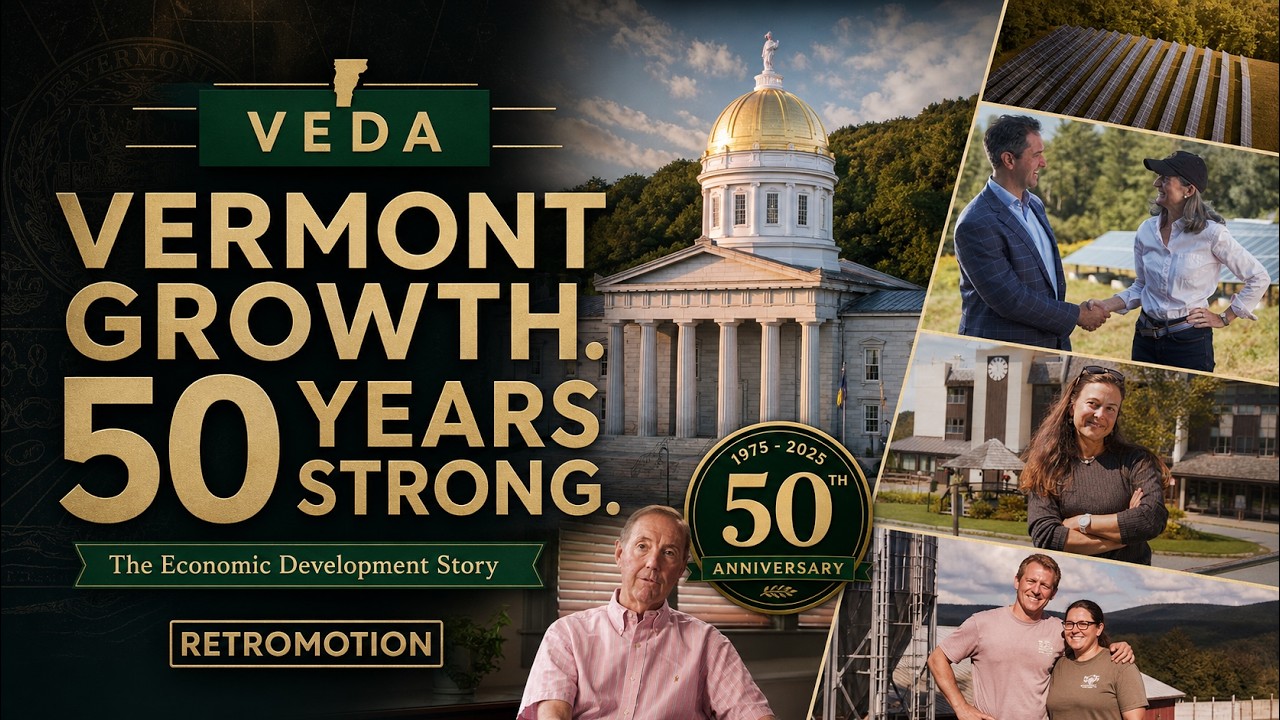
A documentary marking 50 years of the Vermont Economic Development Authority — five decades of financing that helped Vermont farmers, manufacturers, ski resorts, and clean-energy entrepreneurs build durable businesses through downturns, pandemics, and a changing rural economy.
Read the full transcript
For over 50 years, the Vermont Economic Development Authority has helped businesses grow, created jobs, and strengthened communities. Like in our Vermont hometowns, VITA knows the power of dreams and works with entrepreneurs and farmers to bring those dreams to life. It first started as a way to develop industrial parks and attract manufacturing businesses with the intent on creating new sustainable jobs to support and grow the Vermont workforce and economy. In the 1940s, the state lost most of its textile industry.
So the state had a pretty concerted effort to go outside of Vermont and attract manufacturing into Vermont. We had no steady source of new companies to come in to offer jobs or to raise the standard of hay or whatever. We had to build physical industrial parks and VITA was created really to be the financing partner for the state. You have to buy the land to develop a park, you've got to improve it, and then you've got to go out and find companies to buy land.
And so the money is borrowed by the development corp. There's interest on it, and so VITA has to kind of sit and wait and have confidence that there'll be enough lots sold eventually. They would be very patient and they would wait until we sold a piece of land. And they would take part of the proceeds back to pay the interest and to pay the principal.
We could issue taxes and bonds and banks could buy them for quite a wide variety of bigger projects. Those would help those companies finance their projects more cheaply. And the fees that we made on issuing those taxes and revenue bonds helped fund the small business loan program. It was a very methodical process of developing the parks, but it also took a pretty good sales endeavor.
It became clear that the reputation that VITA created could prove to support other areas of the Vermont economy. In the 1980s, VITA responded to the needs of local farmers during a time of highly volatile milk prices. Today, VITA support continues to keep Vermont's agricultural traditions strong and vibrant. The agriculture economy is cyclical.
It can go up, it can go down. It's a national, international market. Right, agriculture has always been very key to Vermont's economy and very well supported by the legislature. VITA was asked to step up and help small and medium sized dairy farmers who had a lot of debt.
Uncertainty in the agricultural business itself propelled the legislature to want to afford to agriculture the same types of beneficial lending that the industrial side of the economy was getting. We see cheese really as a powerful force for good, a way that we can leverage different markets to deliver livable wages for the farmers that we work with and to concentrate wealth back in our community in a way that commodity markets have failed to do. When somebody walks through your barn and starts looking at your cows to buy the whole herd and you have that feeling in your stomach, you know that you're not ready to get out. I thought we were selling the farm, I didn't really think there was any other option.
We had no idea that there were so many options out there. We really thrive on looking at what the opportunities are and the ways that we can really be helpful. In order to succeed here, we need to operate at just a higher frequency and deliver something that is just heads above the rest. Then through the years, we really diversified what we did.
We went beyond the debt stabilization program to really providing financing for all types of agriculture and now forestry as well. VITA has been at the table to work with those farmers, work with those businesses to help them grow and evolve. VITA plays a role in that changing landscape where they can come and get that financing to kickstart that idea and their dream. As it became evident that Vermont was becoming more and more of a tourist destination, VITA expanded in the 1990s to support ski resorts, hotels and attractions welcoming tourists from around the world.
It was incredibly helpful for the tourism community on both sides of the mountain, in particular the resorts to expand their operations and investments. The ski industry by definition is capital intensive business. We've been as frugal as we could possibly be as I think anyone could be, but you couldn't turn it around without capital. We weren't in a position to be bankable at all.
And so really our only banking partner out of the gate was VITA. Traditionally it's not thought of as generating huge jobs, numbers of jobs the way manufacturing is. So it's a slightly different policy goal for the state. It's bringing outside dollars in and that's tax revenue.
So that's important. In 2013, VITA launched a renewable energy program to create a greener future. From solar power to energy efficiency, VITA is building a cleaner tomorrow. VITA was working as an instrumentality of the state of Vermont to form what was really among the first programs of its kind in the nation.
Most of our lending in that space has been in the form of solar energy, either for businesses to install solar at their facility or stand alone solar farms. The role we play is to help get businesses or sectors or lenders over a gap. And that was a big growth area for us. And now we are seeing that other lenders are stepping in and filling that gap.
Across the nation, interconnection of renewable energy projects to the grid is one of the most pressing issues facing not only our industry, but all of us. I think we have seen scientists clearly demonstrate the effects of climate change. When tough times hit, like floods or global pandemics, VITA steps in with emergency loans to keep businesses strong and communities resilient. When the pandemic struck, Sam and VITA in general just really jumped in and understood the struggles that we were going through at the time and really the uncertainty that everyone was going through at the time and really just held out their hand to help us.
And it was really helpful to have Sam and everyone at VITA. They had our backs at that time. Well, there was a definite need. I mean, it was a disaster, natural disaster, that a lot of the businesses were affected.
I mean, you have to think about repayment rates when you're lending money. And the repayment rate was astonishingly high for businesses that had really been hit very hard. So we underwrote the loans quickly and we closed them quickly. VITA is more than a leader.
It's a partner. By working with banks and credit unions, VITA creates a powerful foundation for growth. Ensuring Vermont businesses compete not just locally, but nationally. You've got the legislature.
We have to have good relationships with the legislature. The business community generally are borrowers, state government, the local development corporations. So there's lots of banks. And then the capital markets now that VITA borrows from have to be had.
So there's really quite a few different constituencies to deal with. And what was always interesting and encouraging about VITA was the recognition that they were not the primary lender, if you will, in making these projects happen or making these deals happen, that they were focusing on working with community institutions in Vermont, financial institutions. And that partnership really was embedded in state statute decades ago. And again, as VITA has evolved over the years and the decades, they've stayed true to that recognition, even with the new programs that they've been given by the legislature.
We were able to work with the banks, and that made a real difference because the bank could take a first position, and we can take the second position and get the loan done. That was very important because many of these companies we lent to were very good companies, but they were weak. They didn't have a long performance record. VITA provided that comfort that the banks needed so the loan could be made.
At VITA, creating jobs means building a future for Vermont families, supporting innovation, fueling economic growth, and focusing on wage growth. VITA ensures Vermont remains a place where businesses thrive and workers prosper. With VITA, Vermont's been able to grow in a way that is absolutely perfectly fit for Vermont's character and quality. The emphasis on growing quality businesses and creating high-value-only jobs.
So the growth has been pretty significant, and our business has grown. You know, our top line has more than doubled since we've been here. Approaching our 10-year anniversary here at this place, and where we were able to borrow... A big loan.
A big loan to build a new barn. We went from just the four of us. We're operating at 80 to 90 percent, and we have a team of 82, 83, full-time year-round. We have 400 people on the payroll, but when you multiply that by the families involved, the businesses involved, the amount of money that we put back into the local economy, we're talking about thousands of people that are positively affected.
But you can't tell by looking at a solar array the impact that it had on the community. So with Green Lantern alone, the benefit to the state of Vermont is over a million dollars a year, every year from our arrays. As we look to the future, VITA's mission remains as strong as ever. Helping Vermont businesses grow, innovate, and thrive.
With a legacy of supporting hundreds of world-renowned companies and local entrepreneurs, VITA ensures that Vermont's economy stays competitive and vibrant. VITA is also a respected partner, working with the government and its partners to provide support in times of crisis and shape the industries that keep our state resilient. By adapting the changes in industries and embracing technologies and programs that align with its mission, VITA will continue to build a bright, sustainable future where dreams take root and flourish for generations to come.